














The Fast Facts
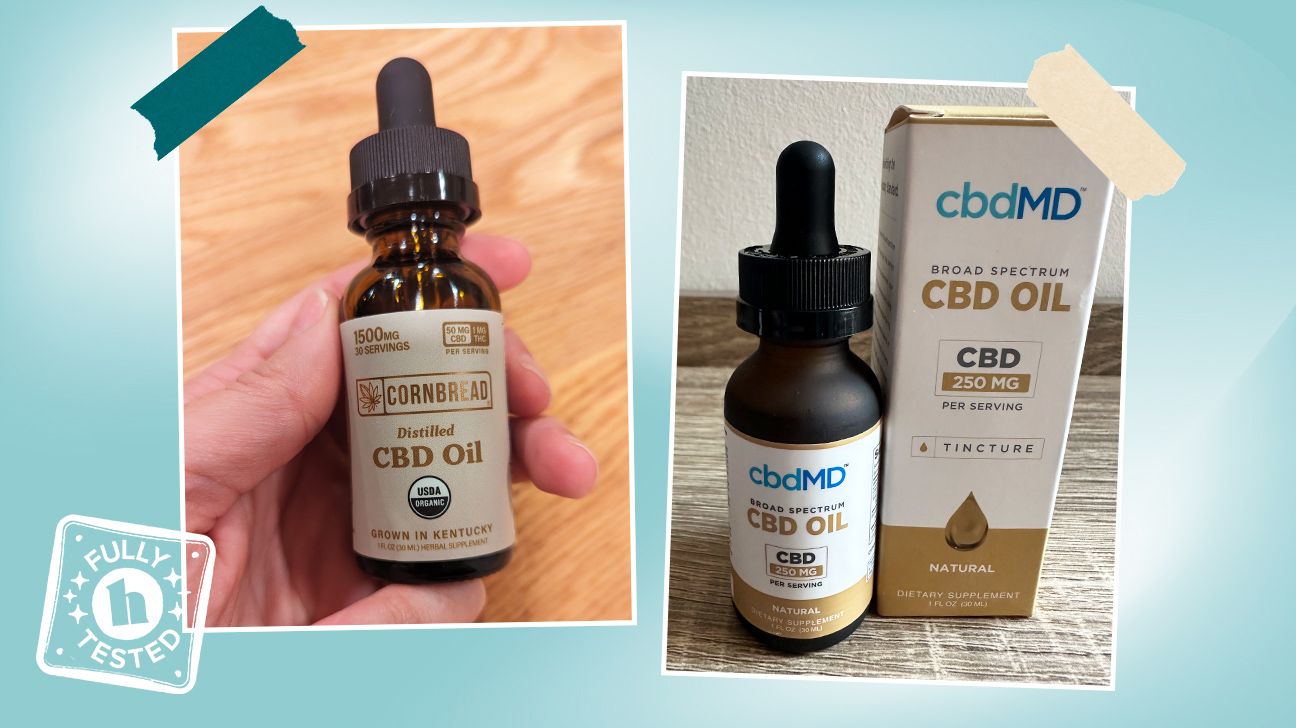
- Our team tested 25 of the best CBD oils. We narrowed the list down to these 8 options based on potency, effects, flavor, and price.
- Cornbread Hemp’s Distilled Oil was a tester favorite and our pick for the best CBD oil overall.
- Lazarus Naturals Full Spectrum CBD Tincture is our pick for the strongest CBD oil, containing up to 6,000 mg of CBD per bottle.
- Best for falling asleep: CBDistillery ahhh Distilled Full-Spectrum CBD Oil, 5,000 mg | Skip to review
(per 30-mL bottle)
• $0.04 to $0.07 per mg
• $0.02 to $0.03 per mg
• $0.04 to $0.08 per mg
• $0.04 to $0.07 per mg
• $0.02 to $0.04 per mg
• $0.07 per mg
• $0.02 to $0.05 per mg
• $0.07 per mg
To create this list, we first put hundreds of CBD oils through our internal vetting process. As part of this process, we consider:
- the product’s composition, ingredients, and overall quality
- any third-party certifications
- the company’s reputation and business practices
- any lab test results
- marketing claims
Then, we tested 25 of the best CBD oils and had our testers provide in-depth feedback on:
- taste
- potency
- ease of use
- positive or negative effects
- packaging and shipping
Testers also score each product. You can read more about how we test and review CBD products, including a detailed look at our guidelines.
The CBD oils that made our list were rated highly by multiple testers both with and without prior CBD experience.
Our Medical Standards and Insights team has carefully researched and vetted over 11,000 products and services. We fact-check health claims, evaluate ingredients, and look into each brand’s reputation before sharing products and services on Healthline.
To choose the products on this page, we considered all the CBD oils that passed our vetting process. Then, we personally tested some of them to narrow down our list even further. Read more about how we test CBD products.
There are a number of potential benefits associated with CBD oil. Research has shown that CBD may:
Plus, alongside CBD gummies, CBD oils are some of the most common forms of CBD you’ll find. When taken sublingually (let to sit under the tongue), CBD oils may also be more effective.
What about the strength of CBD? There are some benefits to using strong CBD, so long as you can tolerate the product’s potency. You will most likely need less of the oil to experience the same effects, which means a bottle might last longer and be more cost-effective.
Hear from an expert
“If sublinguals are applied and absorbed correctly, then the bioavailability can be greater,” explained Dominique Fontaine, BSN, RN, HNB-BC, HWNC-BC, integrative nurse specialist.
She said that this is because the oral mucosa absorbs the CBD, and it avoids traveling through the stomach and liver. Your gastrointestinal system will break down capsules and gummies before they hit your bloodstream, and depending on your unique digestive system, this can
Do not use CBD if you’re pregnant or nursing.
Research from 2017 suggests that some people may experience side effects from CBD. These may include:
- diarrhea
- fatigue
- changes in appetite or weight
Additionally, CBD may interact with some medications. It’s important to talk with your doctor before trying CBD, especially if you’re taking any medications or supplements.
Side effect severity is likely to differ from person to person. None of our testers experienced any side effects when trying the oils in our article.
With so many CBD oils on the market, it can be difficult to narrow down your choices. However, not every product is created equally. Only one CBD product — prescription Epidiolex — is approved by the FDA. Over-the-counter CBD products are not FDA-approved and vary in quality.
Additionally, it’s important to know that CBD oil and hemp seed oil are different. Products containing only hemp seed oil will not contain CBD. Here are some tips to keep in mind when shopping for the best CBD oil for your needs.
- Think about the type of CBD: The different types of CBD will have differing effects on the body. Full-spectrum CBD oil includes all of the compounds in the cannabis plant, including some THC, which may be more potent. Broad-spectrum contains most of the cannabis compounds but only trace amounts of THC. This might be more suitable for people who don’t want to expose themselves to THC. CBD isolate may have the weakest effects because it only contains CBD. However, it’s completely free of THC.
- Consider the CBD dose: Always start with a small dose to see how you react to CBD oil. Appropriate serving sizes for CBD vary greatly depending on individual factors, such as intended use, body weight, metabolism, and body chemistry. Over time, you can increase the dose and frequency until you achieve your desired results. However, be sure to talk with a healthcare professional before changing the recommended dosage.
- Look for third-party testing: It’s safest to only buy CBD that has gone through third-party testing. This means an independent testing lab analyses a brand’s CBD oil to ensure it only contains what’s listed on the label and at the stated dose. Labs will also test for contaminants. Reputable CBD brands will make test results accessible on their website or product packaging.
When they tried CBD oils, our testers used them in a couple different ways:
Direct to mouth
- Shake the bottle to ensure proper consistency.
- Dispense the dosage suggested by the manufacturer.
- Hold the oil under your tongue for 30 seconds to a few minutes for maximum absorption.
- Swallow.
Add to beverage
- Shake the bottle to ensure proper consistency.
- Dispense the suggested dose into a beverage of your choice, like coffee or tea.
- Stir.
- Drink as usual.
To determine how many drops to take or add to your beverage, follow the suggested dosage provided by the manufacturer or your healthcare professional.
Doses should be taken at least 4 to 6 hours apart. You can take CBD at any time of day. However, if you’re using CBD to improve sleep, take it before bed.
The immediate effects of CBD usually take effect within 30 to 90 minutes, but long-term results may take several weeks to achieve.
Store CBD oils and tinctures in a dry, cool place away from direct heat and sunlight. Make sure the cap is closed tightly after each use. It’s not necessary to refrigerate the product, but it may help prolong its shelf life.
Avoid touching your mouth with the dropper to prevent bacterial contamination and preserve the quality of the oil.
No, you do not need to take CBD oil with food. But if you don’t like the taste, you may find that ingesting CBD oil by mixing it with a beverage gives it a better taste.
Be cautious if taking CBD alongside a high-fat meal. Some research shows that this increases the bioavailability of CBD, which may increase your risk for side effects.
The strongest CBD oil on our list,
There are CBD tinctures as strong as 10,000 mg per bottle, but those are typically helpful for very experienced users.
Evidence suggests that CBD is pretty safe to use, though it may cause mild side effects in some people.
If you’re taking any prescription medications or over-the-counter supplements, it’s a wise idea to talk with a healthcare professional before mixing CBD with your current medications. CBD may interact with medications.
Because CBD isn’t rigorously regulated, it’s important to buy only from reputable sources. This helps make sure that you’re consuming the safest version of the product available.
It may take some trial and error with CBD oils at varying potency levels to decide if a stronger CBD oil is best for your needs.
Side effects may be more likely at higher dosages.
A 2020 systematic review of human trials showed CBD to be relatively safe at various doses. Most of the studies in this review used daily doses of 300 mg to 600 mg.
Note that these doses are specific to the populations included in the studies and may not be the right dose for you.
Your individual needs will determine which type of CBD is most effective.
If you’re looking for stronger effects, you may prefer full-spectrum CBD over an isolate or broad-spectrum product. Oils and gummies may have calming and relaxing effects across your whole body, while topical products will provide more targeted relief from pain.
CBD oil is generally well tolerated and safe to use, though negative reactions, such as fatigue and digestive issues, are possible.
Talk with your healthcare professional before taking CBD if you’re pregnant or breastfeeding, have any medical conditions, or take any over-the-counter or prescription medications or supplements.
CBD is legal in many parts of the United States, but most manufacturers require you to be at least age 18 years old to purchase their product. It may not be legal in all countries.
Check your local laws before buying CBD. When buying online, confirm with the manufacturer that it’ll ship to your area, but also check local laws.
Since CBD products can contain trace amounts of THC, it’s still possible for them to show up on a drug test. Avoid taking CBD products if this is a concern.
Healthline has sole editorial control over this article. Potential uses for the products listed here are not health claims made by the manufacturers. The information in this article is intended to be general in nature. It’s not intended to be a substitute for medical advice from a healthcare professional. Healthline encourages you to make any treatment decisions with your healthcare professional.
Is CBD legal? The 2018 Farm Bill removed hemp from the legal definition of marijuana in the Controlled Substances Act. This made some hemp-derived CBD products with less than 0.3% THC legal at the federal level. However, CBD products containing more than 0.3% THC still fall under the legal definition of marijuana, making them illegal at the federal level. Some states have legalized CBD, so be sure to check state laws, especially when traveling. Also, keep in mind that the FDA has not approved nonprescription CBD products, and some products may be inaccurately labeled.